Shaun Hiscox is Co-Founder and Director of Castra Financial. He has worked in financial services since 2009 and co-founded Castra in 2020, leading client relationships with a people-first approach shaped by 17 years in the profession. He holds the CeMAP and DipFA qualifications and is committed to making quality financial advice available to everyone, not just the wealthy.
Learn more about Castra Financial →Key Facts
- How you draw your retirement income can make a real difference to the tax you pay.
- Everyone has a personal allowance, £12,570, that can be received tax-free (source: GOV.UK).
- ISA withdrawals are entirely tax-free and do not count towards your taxable income.
- Spreading pension withdrawals to stay within lower tax bands can reduce your bill.
- Using both partners’ allowances and tax bands can cut a couple’s total tax.
- Taking your tax-free cash in stages, rather than all at once, can help too.
- The order you draw from your different pots is where much of the saving is made.
Two people with identical savings can end up paying very different amounts of tax in retirement, purely because of how they draw their money. Retirement tax is one of the most overlooked opportunities to keep more of what you have worked for. This article explains practical income planning strategies to pay less tax in retirement, all within the rules.
The good news is that the UK tax system gives you real levers to pull in retirement. Using your allowances, your tax bands, and your different types of savings deliberately can leave noticeably more money in your pocket.
Make Full Use of Your Personal Allowance
The simplest way to reduce tax in retirement is to make full use of your personal allowance, the amount of income you can receive each year before paying any income tax. It is currently £12,570.
Many people leave part of their personal allowance unused in some years and pay higher-rate tax in others, when spreading their income more evenly would have kept more of it tax-free. Drawing enough taxable income each year to use your allowance, without pushing yourself into a higher band, is a foundation of tax-efficient retirement income. Income tax bands differ in Scotland, so the exact thresholds depend on where you live.
Draw Tax-Free Income From ISAs
Because everything you take from an ISA is free of tax, ISA withdrawals are a powerful tool for managing your retirement tax bill. Money drawn from an ISA does not count towards your taxable income at all.
This lets you top up your income without increasing your tax, or fund years where drawing more from your pension would push you into a higher band. Blending taxable pension income with tax-free ISA income gives you fine control over the tax you pay each year. It is one of the clearest reasons to build ISA savings alongside pensions during your working life.
Spread Withdrawals to Stay in Lower Tax Bands
Taking large amounts from your pension in a single year can push you into a higher tax band, so spreading withdrawals over several years often reduces your overall tax. Income beyond your tax-free cash is taxed as income, and the more you take at once, the more likely some of it is taxed at a higher rate.
By drawing a steady income that stays within the basic-rate band, and topping up from tax-free sources where needed, you can avoid paying higher-rate tax unnecessarily. This is particularly important when taking one-off lump sums, which can have an outsized effect on the tax due that year. Planning the timing of larger withdrawals is where careful thought pays off.
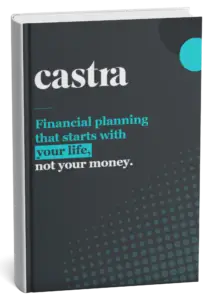
Get the Castra Retirement Planning Guide
Want to keep more of your retirement income? The Castra retirement planning guide explains how to draw your money tax-efficiently, in plain English, at your own pace.
Use Both Partners’ Allowances and Bands
For couples, one of the most effective tax strategies is to make use of both partners’ personal allowances and tax bands, rather than concentrating income in one person. Each partner has their own allowance and their own lower-rate bands.
- Draw income so that both personal allowances are used
- Hold savings and pensions in a way that spreads taxable income across both partners
- Keep each partner within lower tax bands where possible
A couple who share their income sensibly can pay considerably less tax than one where the income is loaded onto a single person. Arranging which partner holds which savings, and who draws what, is a valuable part of planning for a couple.
Take Your Tax-Free Cash Thoughtfully
How and when you take your tax-free cash also affects your tax, because taking it in stages rather than all at once can help manage your taxable income. You are entitled to a quarter of a defined contribution pension free of tax, and you do not have to take it in one go.
Drawing tax-free cash gradually, alongside taxable income, lets you keep more of your pot invested and can smooth your tax across the years. Taking a very large lump sum in one year rarely helps your tax position and can leave less invested for the future. Coordinating your tax-free cash with the rest of your income is part of a joined-up plan.
Why the Order of Withdrawals Matters
The single biggest factor in retirement tax is the order in which you draw from your different pots, because each is taxed differently. Getting the sequence right can save a meaningful amount over the course of retirement.
Broadly, using tax-free and lower-taxed sources to manage your position each year, while leaving other money to grow, can reduce your lifetime tax bill. The right order depends on your mix of pensions, ISAs, and other savings, and on your circumstances each year. Tax treatment depends on individual circumstances and may be subject to change, so this is an area where a tailored plan, reviewed regularly, earns its keep.
Frequently Asked Questions About Paying Less Tax in Retirement
How can I reduce my tax in retirement?
You can reduce your tax by making full use of your personal allowance, drawing tax-free income from ISAs, spreading pension withdrawals to stay within lower tax bands, using both partners’ allowances if you are a couple, and taking your tax-free cash thoughtfully. The order in which you draw from your different pots is where much of the saving is made.
Do I pay tax on my pension in retirement?
Up to a quarter of a defined contribution pension can usually be taken tax-free, with the remainder taxed as income as you draw it against your personal allowance and tax bands. The State Pension is also taxable. ISA withdrawals, by contrast, are entirely tax-free, which is why blending sources helps manage your overall tax.
How does my personal allowance work in retirement?
Your personal allowance, £12,570, is the amount of income you can receive each year before paying income tax. Using it fully each year, without pushing yourself into a higher band, keeps more of your income tax-free. Income tax bands differ in Scotland, so the exact figures depend on where you live.
Ready to Keep More of Your Retirement Income?
Small differences in how you draw your money can add up to a large difference in tax over a retirement. Getting your income planned tax-efficiently is worth a proper conversation.
A first conversation with the Castra team is free, with no obligation and no pressure. Let’s make your retirement income as tax-efficient as it can be.
TL;DR: How to Pay Less Tax in Retirement: Income Planning Strategies
How you draw your income, not just how much you have, decides your retirement tax bill, and a few strategies can keep more of it in your pocket.
- Use your full personal allowance, £12,570, each year.
- Draw tax-free income from ISAs to top up without adding to your tax.
- Spread pension withdrawals to stay within lower tax bands.
- Use both partners’ allowances and bands if you are a couple.
- Take your tax-free cash in stages rather than all at once.
- The order you draw from your pots is where much of the saving is made.
This article is for information only and does not constitute financial advice. Any advice would be personalised to your individual circumstances. Tax treatment depends on individual circumstances and may be subject to change, and tax rules differ in Scotland. The value of investments can fall as well as rise, and you may get back less than you invest. Figures quoted are correct at the date of publication and are subject to change. Castra Financial is authorised and regulated by the Financial Conduct Authority.